In the Short Run, a Firm Operating in a Monopolistically Competitive Market Can Earn
Defining Monopolistic Competition
Monopolistic contest is a blazon of imperfect competition such that many producers sell products that are differentiated from 1 another.
Learning Objectives
Evaluate the characteristics and outcomes of markets with imperfect competition
Key Takeaways
Key Points
- Monopolistic competition is different from a monopoly. A monopoly exists when a person or entity is the exclusive supplier of a good or service in a marketplace.
- Markets that accept monopolistic competition are inefficient for two reasons. Offset, at its optimum output the firm charges a price that exceeds marginal costs. The 2nd source of inefficiency is the fact that these firms operate with excess chapters.
- Monopolistic competitive markets accept highly differentiated products; accept many firms providing the good or service; firms tin can freely enter and exits in the long-run; firms can make decisions independently; there is some degree of market power; and buyers and sellers have imperfect information.
Key Terms
- monopoly: A market where one company is the sole supplier.
- Monopolistic competition: A type of imperfect contest such that one or two producers sell products that are differentiated from one another as goods but non perfect substitutes (such as from branding, quality, or location).
Monopolistic Competition
Monopolistic contest is a type of imperfect competition such that many producers sell products that are differentiated from one another equally goods merely not perfect substitutes (such every bit from branding, quality, or location). In monopolistic competition, a firm takes the prices charged past its rivals as given and ignores the impact of its own prices on the prices of other firms.
Unlike in perfect competition, firms that are monopolistically competitive maintain spare capacity. Models of monopolistic contest are often used to model industries. Textbook examples of industries with market structures similar to monopolistic competition include restaurants, cereal, clothing, shoes, and service industries in large cities.

Clothing: The wear industry is monopolistically competitive because firms have differentiated products and market power.
Monopolistic competition is unlike from a monopoly. A monopoly exists when a person or entity is the sectional supplier of a good or service in a marketplace. The demand is inelastic and the market is inefficient.
Monopolistic competitive markets:
- have products that are highly differentiated, meaning that in that location is a perception that the goods are different for reasons other than price;
- have many firms providing the good or service;
- firms tin can freely enter and exits in the long-run;
- firms can brand decisions independently;
- there is some degree of market ability, meaning producers accept some command over price; and
- buyers and sellers have imperfect information.
Sources of Market Inefficiency
Markets that have monopolistic competition are inefficient for two reasons. The kickoff source of inefficiency is due to the fact that at its optimum output, the business firm charges a price that exceeds marginal costs. The monopolistic competitive firm maximizes profits where marginal acquirement equals marginal cost. A monopolistic competitive firm's demand curve is downward sloping, which means it will charge a price that exceeds marginal costs. The market power possessed by a monopolistic competitive business firm means that at its profit maximizing level of production there volition be a net loss of consumer and producer surplus.
The 2d source of inefficiency is the fact that these firms operate with backlog capacity. The firm's turn a profit maximizing output is less than the output associated with minimum boilerplate cost. All firms, regardless of the type of market it operates in, will produce to a indicate where demand or price equals average cost. In a perfectly competitive market, this occurs where the perfectly elastic demand curve equals minimum boilerplate cost. In a monopolistic competitive market, the need curve is downward sloping. In the long run, this leads to excess chapters.
Product Differentiation
Production differentiation is the procedure of distinguishing a product or service from others to make information technology more than attractive to a target market.
Learning Objectives
Define product differentiation
Fundamental Takeaways
Key Points
- Differentiation occurs because buyers perceive a divergence between products. Causes of differentiation include functional aspects of the production or service, how it is distributed and marketed, and who buys it.
- Differentiation affects performance primarily by reducing direct competition. As the product becomes more unlike, categorization becomes more than difficult, and the product draws fewer comparisons with its competition.
- There are three types of product differentiation: uncomplicated, horizontal, and vertical.
Key Terms
- product differentiation: Perceived differences between the product of one firm and that of its rivals so that some customers value it more.
One of the defining traits of a monopolistically competitive marketplace is that there is a significant corporeality of not- price competition. This ways that product differentiation is key for any monopolistically competitive firm. Production differentiation is the procedure of distinguishing a product or service from others to make it more than attractive to a target market.

Kool-Help: Kool-Aid is an individual make that competes with Kraft's other brand (Tang).
Although inquiry in a niche market place may result in irresolute a product in order to amend differentiation, the changes themselves are not differentiation. Marketing or product differentiation is the process of describing the differences between products or services, or the resulting listing of differences; differentiation is not the process of creating the differences between the products. Production differentiation is washed in club to demonstrate the unique aspects of a house's product and to create a sense of value.
In economic science, successful product differentiation is inconsistent with the weather condition of perfect competition, which require products of competing firms to be perfect substitutes.
Consumers do not need to know everything about the production for differentiation to piece of work. And so long as the consumers perceive that there is a difference in the products, they do non need to know how or why one product might be of higher quality than another. For case, a generic brand of cereal might be exactly the same equally a brand name in terms of quality. However, consumers might be willing to pay more than for the make name despite the fact that they cannot identify why the more expensive cereal is of higher "quality."
There are three types of product differentiation:
- Elementary: the products are differentiated based on a variety of characteristics;
- Horizontal: the products are differentiated based on a single characteristic, merely consumers are not clear on which product is of college quality; and
- Vertical: the products are differentiated based on a single characteristic and consumers are clear on which product is of college quality.
Differentiation occurs considering buyers perceive a difference. Drivers of differentiation include functional aspects of the production or service, how information technology is distributed and marketed, and who buys information technology. The major sources of product differentiation are as follows:
- Differences in quality, which are usually accompanied by differences in cost;
- Differences in functional features or design;
- Ignorance of buyers regarding the essential characteristics and qualities of goods they are purchasing;
- Sales promotion activities of sellers, particularly advertising; and
- Differences in availability (e.g. timing and location).
The objective of differentiation is to develop a position that potential customers see as unique. Differentiation affects functioning primarily by reducing straight contest. Every bit the production becomes more dissimilar, categorization becomes more difficult, and the product draws fewer comparisons with its competition. A successful product differentiation strategy will move the product from competing on price to competing on non-cost factors.
Demand Curve
The demand bend in a monopolistic competitive market slopes downward, which has several important implications for firms in this market place.
Learning Objectives
Explain how the shape of the need curve affects the firms that exist in a market with monopolistic competition
Key Takeaways
Key Points
- The downward gradient of a monopolistically competitive demand curve signifies that the firms in this industry have market place power.
- Market power allows firms to increase their prices without losing all of their customers.
- The downward slope of the need bend contributes to the inefficiency of the market, leading to a loss in consumer surplus, deadweight loss, and excess production capacity.
Key Terms
- market place power: The ability of a firm to profitably heighten the market toll of a good or service over marginal toll. A firm with full market power can raise prices without losing whatsoever customers to competitors.
- elastic: Sensitive to changes in toll.
The demand curve of a monopolistic competitive market slopes downward. This ways that as price decreases, the quantity demanded for that good increases. While this appears to exist relatively straightforward, the shape of the demand curve has several important implications for firms in a monopolistic competitive market place.
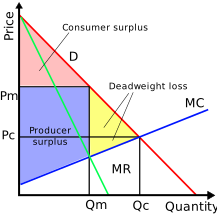
Monopolistic Contest: Equally you can see from this chart, the demand curve (marked in scarlet) slopes downward, signifying elastic demand.
Market place Power
The demand curve for an individual house is downwardly sloping in monopolistic contest, in contrast to perfect competition where the firm'southward individual demand bend is perfectly elastic. This is due to the fact that firms have market power: they tin can raise prices without losing all of their customers. In this blazon of marketplace, these firms take a express ability to dictate the cost of its products; a firm is a price setter not a price taker (at least to some degree). The source of the market power is that there are comparatively fewer competitors than in a competitive marketplace, so businesses focus on product differentiation, or differences unrelated to price. By differentiating its products, firms in a monopolistically competitive market ensure that its products are imperfect substitutes for each other. As a issue, a concern that works on its branding can increase its prices without risking its consumer base.
Inefficiency in the Market
Monopolistically competitive firms maximize their profit when they produce at a level where its marginal costs equals its marginal revenues. Considering the individual house's demand curve is downwards sloping, reflecting market power, the toll these firms will charge will exceed their marginal costs. Due to how products are priced in this market place, consumer surplus decreases below the pareto optimal levels you would notice in a perfectly competitive market, at to the lowest degree in the brusque run. As a event, the marketplace volition suffer deadweight loss. The suppliers in this market will also accept excess production capacity.
Short Run Event of Monopolistic Contest
Monopolistic competitive markets can atomic number 82 to significant profits in the short-run, but are inefficient.
Learning Objectives
Examine the concept of the short run and how it applies to firms in a monopolistic competition
Key Takeaways
Key Points
- The "short run" is the fourth dimension flow when one factor of production is fixed in terms of costs, while the other elements of product are variable.
- Like monopolies, the suppliers in monopolistic competitive markets are price makers and will carry similarly in the short-run.
- Also like a monopoly, a monopolastic competitive firm will maximize its profits when its marginal revenues equals its marginal costs.
Cardinal Terms
- short-run: The conceptual time period in which at to the lowest degree one factor of product is fixed in amount and others are variable in corporeality.
In terms of production and supply, the "short run" is the time flow when one cistron of product is stock-still in terms of costs while the other elements of product are variable. The most common case of this is the production of a skillful that requires a factory. If demand spikes, in the curt run you volition but be able to produce the amount of good that the chapters of the factory allows. This is considering it takes a significant amount of fourth dimension to either build or acquire a new factory. If demand for the good plummets you tin cut production in the factory, but will still have to pay the costs of maintaining the mill and the associated rent or debt associated with acquiring the mill. You could sell the factory, only again that would take a significant amount of time. The "short run" is defined past how long it would accept to alter that "fixed" aspect of product.
In the curt run, a monopolistically competitive market place is inefficient. It does non achieve allocative nor productive efficiency. Also, since a monopolistic competitive firm has powers over the market place that are like to a monopoly, its profit maximizing level of production will result in a net loss of consumer and producer surplus, creating deadweight loss.
Setting a Price and Determining Profit
Like monopolies, the suppliers in monopolistic competitive markets are price makers and will bear similarly in the short-run. Besides like a monopoly, a monopolistic competitive house will maximize its profits by producing goods to the point where its marginal revenues equals its marginal costs. The turn a profit maximizing cost of the good will exist determined based on where the turn a profit-maximizing quantity amount falls on the average acquirement bend. The profit the firm makes is the the amount of the adept produced multiplied by the departure between the price minus the boilerplate cost of producing the skilful..

Short Run Equilibrium Under Monopolistic Competition: As you can see from the chart, the firm will produce the quantity (Qs) where the marginal toll (MC) bend intersects with the marginal revenue (MR) curve. The price is set based on where the Qs falls on the boilerplate revenue (AR) curve. The profit the firm makes in the brusk term is represented by the grayness rectangle, or the quantity produced multiplied by the difference betwixt the toll and the average cost of producing the good.
Since monopolistically competitive firms have market place power, they will produce less and charge more than a house would under perfect competition. This causes deadweight loss for society, but, from the producer'southward indicate of view, is desirable because it allows them to earn a profit and increase their producer surplus.
Because of the possibility of big profits in the short-run and relatively low barriers of entry in comparison to perfect markets, markets with monopolistic competition are very attractive to future entrants.
Long Run Outcome of Monopolistic Competition
In the long run, firms in monopolistic competitive markets are highly inefficient and can only break even.
Learning Objectives
Explicate the concept of the long run and how it applies to a firms in monopolistic competition
Key Takeaways
Fundamental Points
- In terms of product and supply, the " long-run " is the time period when all aspects of production are variable and tin can therefore be adjusted to meet shifts in demand.
- Similar monopolies, the suppliers in monopolistic competitive markets are cost makers and will deport similarly in the long-run.
- Like a monopoly, a monopolastic competitive firm will maximize its profits by producing goods to the indicate where its marginal revenues equals its marginal costs.
- In the long-run, the demand curve of a firm in a monopolistic competitive market will shift so that information technology is tangent to the firm'due south average total cost curve. Every bit a result, this will make it incommunicable for the house to make economic turn a profit; it will only exist able to break fifty-fifty.
Key Terms
- long-run: The conceptual time period in which there are no fixed factors of product.
In terms of production and supply, the "long-run" is the time menses when in that location is no gene that is fixed and all aspects of product are variable and tin therefore be adjusted to come across shifts in demand. Given a long enough time period, a house can take the following actions in response to shifts in demand:
- Enter an industry;
- Exit an industry;
- Increment its capacity to produce more; and
- Subtract its chapters to produce less.
In the long-run, a monopolistically competitive market is inefficient. It achieves neither allocative nor productive efficiency. Also, since a monopolistic competitive business firm has power over the market that is like to a monopoly, its profit maximizing level of production will result in a net loss of consumer and producer surplus.
Setting a Toll and Determining Profit
Like monopolies, the suppliers in monopolistic competitive markets are price makers and volition acquit similarly in the long-run. Too like a monopoly, a monopolistic competitive firm will maximize its profits by producing goods to the bespeak where its marginal revenues equals its marginal costs. The profit maximizing toll of the skilful will exist determined based on where the profit-maximizing quantity amount falls on the average revenue bend.
While a monopolistic competitive firm can make a profit in the brusk-run, the result of its monopoly-like pricing will cause a decrease in demand in the long-run. This increases the need for firms to differentiate their products, leading to an increase in boilerplate full cost. The decrease in demand and increase in cost causes the long run average cost curve to get tangent to the need curve at the good's profit maximizing price. This means 2 things. Offset, that the firms in a monopolistic competitive market will produce a surplus in the long run. Second, the firm will only be able to interruption even in the long-run; information technology will not exist able to earn an economic profit.
Long Run Equilibrium of Monopolistic Contest: In the long run, a house in a monopolistic competitive market place will production the amount of goods where the long run marginal cost (LRMC) curve intersects marginal acquirement (MR). The toll will be prepare where the quantity produced falls on the average revenue (AR) curve. The consequence is that in the long-term the house will break even.
Monopolistic Competition Compared to Perfect Competition
The primal divergence betwixt perfectly competitive markets and monopolistically competitive ones is efficiency.
Learning Objectives
Differentiate between monopolistic competition and perfect competition
Fundamental Takeaways
Primal Points
- Perfectly competitive markets take no barriers of entry or exit. Monopolistically competitive markets have a few barriers of entry and exit.
- The two markets are similar in terms of elasticity of demand, a firm 's power to brand profits in the long-run, and how to determine a firm'south profit maximizing quantity condition.
- In a perfectly competitive market, all appurtenances are substitutes. In a monopolistically competitive marketplace, there is a high caste of production differentiation.
Key Terms
- perfect competition: A blazon of market with many consumers and producers, all of whom are price takers
Perfect competition and monopolistic competition are two types of economic markets.
Similarities
One of the key similarities that perfectly competitive and monopolistically competitive markets share is elasticity of demand in the long-run. In both circumstances, the consumers are sensitive to price; if toll goes up, demand for that production decreases. The two only differ in degree. Firm'southward private demand curves in perfectly competitive markets are perfectly elastic, which ways that an incremental increase in price volition cause need for a product to vanish ). Need curves in monopolistic competition are not perfectly elastic: due to the market power that firms have, they are able to raise prices without losing all of their customers.
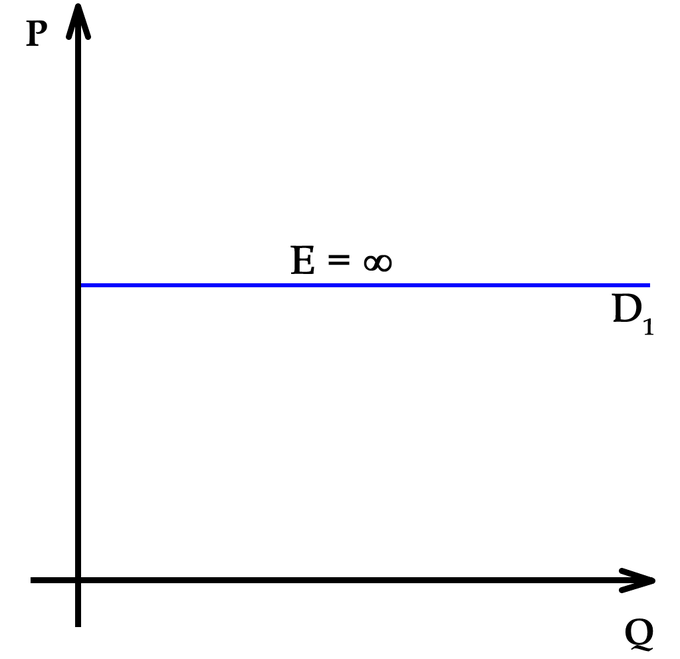
Demand curve in a perfectly competitive market place: This is the demand curve in a perfectly competitive marketplace. Notation how whatsoever increment in price would wipe out demand.
Also, in both sets of circumstances the suppliers cannot brand a turn a profit in the long-run. Ultimately, firms in both markets will just be able to break even by selling their goods and services.
Both markets are composed of firms seeking to maximize their profits. In both of these markets, profit maximization occurs when a firm produces appurtenances to such a level and so that its marginal costs of product equals its marginal revenues.
Differences
I key departure between these ii set of economical circumstances is efficiency. A perfectly competitive market is perfectly efficient. This means that the toll is Pareto optimal, which means that any shift in the toll would benefit i party at the expense of the other. The overall economic surplus, which is the sum of the producer and consumer surpluses, is maximized. The suppliers cannot influence the price of the skilful or service in question; the market place dictates the price. The price of the good or service in a perfectly competitive market is equal to the marginal costs of manufacturing that good or service.
In a monopolistically competitive market place the toll is higher than the marginal cost of producing the good or service and the suppliers can influence the cost, granting them marketplace power. This decreases the consumer surplus, and by extension the marketplace'due south economic surplus, and creates deadweight loss.
Another cardinal divergence betwixt the two is product differentiation. In a perfectly competitive marketplace products are perfect substitutes for each other. Only in monopolistically competitive markets the products are highly differentiated. In fact, firms work hard to emphasize the not-price related differences between their products and their competitors'.
A last difference involves barriers to entry and exit. Perfectly competitive markets have no barriers to entry and leave; a firm can freely enter or get out an manufacture based on its perception of the market'due south profitability. In a monopolistic competitive market there are few barriers to entry and exit, but still more in a perfectly competitive market place.
Efficiency of Monopolistic Competition
Monopolistic competitive markets are never efficient in any economic sense of the term.
Learning Objectives
Discuss the issue monopolistic contest has on overall market efficiency
Key Takeaways
Key Points
- Considering a adept is always priced college than its marginal cost, a monopolistically competitive market tin never accomplish productive or allocative efficiency.
- Suppliers in monopolistically competitive firms will produce below their chapters.
- Because monopolistic firms set prices higher than marginal costs, consumer surplus is significantly less than it would be in a perfectly competitive marketplace. This leads to deadweight loss and an overall decrease in economic surplus.
Key Terms
- consumer surplus: The difference between the maximum cost a consumer is willing to pay and the actual price they do pay.
- producer surplus: The amount that producers do good by selling at a market price that is higher than the lowest cost at which they would be willing to sell.
Monopolistically competitive markets are less efficient than perfectly competitive markets.
Producer and Consumer Surplus
In terms of economical efficiency, firms that are in monopolistically competitive markets behave similarly as monopolistic firms. Both types of firms' profit maximizing production levels occur when their marginal revenues equals their marginal costs. This quantity is less than what would be produced in a perfectly competitive market. Information technology also means that producers will supply goods below their manufacturing capacity.
Firms in a monopolistically competitive market are price setters, meaning they get to unilaterally charge whatever they want for their goods without being influenced by market forces. In these types of markets, the price that will maximize their profit is fix where the profit maximizing product level falls on the demand curve.This price exceeds the house's marginal costs and is college than what the firm would charge if the market was perfectly competitive. This means two things:
- Consumers will have to pay a higher price than they would in a perfectly competitive marketplace, leading to a significant decline in consumer surplus; and
- Producers will sell less of their appurtenances than they would have in a perfectly competitive market, which could commencement their gains from charging a higher price and could result in a decline in producer surplus.
Regardless of whether in that location is a decline in producer surplus, the loss in consumer surplus due to monopolistic competition guarantees deadweight loss and an overall loss in economic surplus.
Inefficiency in Monopolistic Competition: Monopolistic competition creates deadweight loss and inefficiency, as represented by the yellow triangle. The quantity is produced when marginal revenue equals marginal cost, or where the green and blue lines intersect. The price is determined based on where the quantity falls on the demand curve, or the red line. In the short run, the monopolistic competition marketplace acts like a monopoly.
Productive and Allocative Efficiency
Productive efficiency occurs when a market is using all of its resources efficiently. This occurs when a product's price is gear up at its marginal cost, which also equals the product's boilerplate full cost. In a monopolistic competitive marketplace, firms e'er set the toll greater than their marginal costs, which means the market can never be productively efficient.
Allocative efficiency occurs when a good is produced at a level that maximizes social welfare. This occurs when a product's price equals its marginal benefits, which is also equal to the product'southward marginal costs. Over again, since a adept's price in a monopolistic competitive market always exceeds its marginal price, the market tin can never exist allocatively efficient.
Advert and Make Management in Monopolistic Contest
Advertising and branding help firms in monopolistic competitive markets differentiate their products from those of their competitors.
Learning Objectives
Evaluate whether advertising is beneficial or detrimental to consumers
Primal Takeaways
Key Points
- A company's brand can assistance promote quality in that company's products.
- Advertizement helps inform consumers virtually products, which decreases option costs.
- Costs associated with advertisement and branding include higher prices, customers mislead by simulated advertisements, and negative societal affects such every bit perpetuating stereotypes and spam.
Key Terms
- make: The reputation of an arrangement, a product, or a person among some segment of the population.
- advertising: Communication with the purpose of influencing potential customers most products and services
Ane of the characteristics of a monopolistic competitive market is that each firm must differentiate its products. Two ways to exercise this is through advertising and cultivating a brand. Advert is a form of advice meant to inform, educate, and influence potential customers about products and services. Advertising is generally used by businesses to cultivate a brand. A make is a company's reputation in relation to products or services sold under a specific proper name or logo.
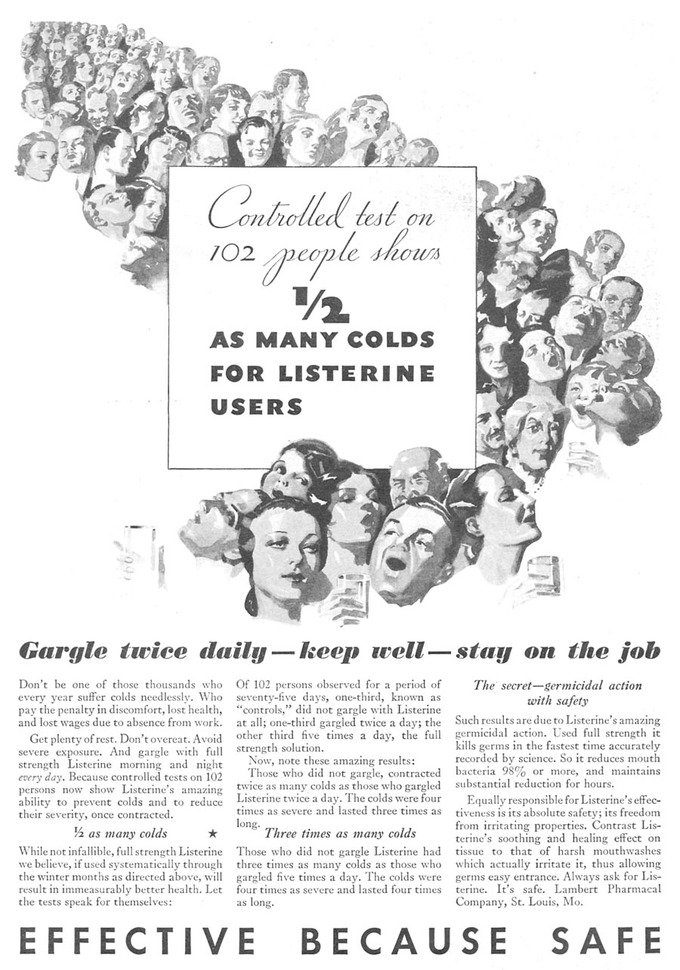
Listerine ad, 1932: From 1921 until the mid-1970s, Listerine was as well marketed every bit preventive and a remedy for colds and sore throats. In 1976, the Federal Trade Committee ruled that these claims were misleading, and that Listerine had "no efficacy" at either preventing or alleviating the symptoms of sore throats and colds. Warner-Lambert was ordered to stop making the claims and to include in the side by side $10.2 million dollars of Listerine ads specific mention that "reverse to prior advertisement, Listerine will not help prevent colds or sore throats or lessen their severity. "
Benefits of Advertising and Branding
The purpose of the brand is to generate an immediate positive reaction from consumers when they see a production or service existence sold nether a certain name in club to increase sales. A make and the associated reputation are congenital on ad and consumers' past experiences with the products associated with that brand.
Reputation amidst consumers is important to a monopolistically competitive business firm because it is arguably the best way to differentiate itself from its competitors. However, for that reputation to be maintained, the business firm must ensure that the products associated with the brand name are of the highest quality. This standard of quality must be maintained at all times because it just takes one bad experience to ruin the value of the make for a segment of consumers. Brands and advertising tin can thus help guarantee quality products for consumers and society at big.
Advertising is also valuable to gild because it helps inform consumers. Markets work best when consumers are well informed, and advertising provides that data. Advertising and brands can assistance minimize the costs of choosing between dissimilar products considering of consumers' familiarity with the firms and their quality.
Finally, advertizing allows new firms to enter into a market. Consumers might be hesitant to purchase products with which they are unfamiliar. Advertising tin brainwash and inform those consumers, making them comfy enough to give those products a try.
Costs of Advert and Branding
There are some concerns about how advertising tin can damage consumers and society too. Some believe that advertizement and branding induces customers to spend more on products because of the name associated with them rather than because of rational factors. Further, there is no guarantee that advertisements accurately describe products; they tin can mislead consumers. Finally, advertising can have negative societal effects such equally the perpetuation of negative stereotypes or the nuisance of "spam. "
Source: https://courses.lumenlearning.com/boundless-economics/chapter/monopolistic-competition/
0 Response to "In the Short Run, a Firm Operating in a Monopolistically Competitive Market Can Earn"
Enviar um comentário