Book Review of Bounce Living the Resilient Life
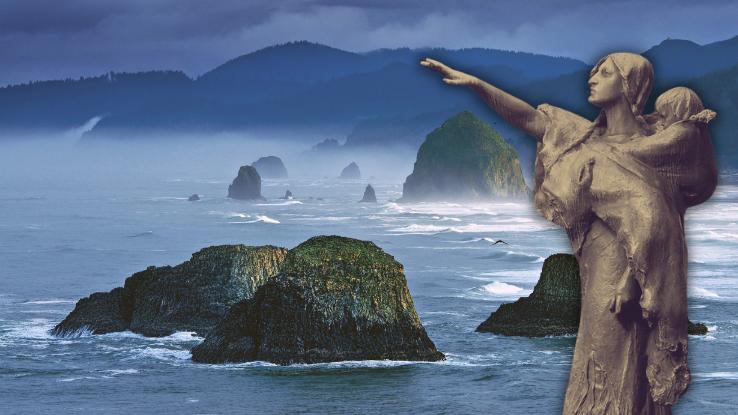
If yous learned of Sacagawea in your high-school history grade, information technology'south likely that y'all think of her as a key part of the Lewis and Clark Trek. But the common delineation of Sacagawea is thoroughly distorted; many truths about her, and her circumstances, have either been twisted or left out entirely in guild to suit a particular narrative. That is, the trek was meant to be a heroic, American endeavor, and, every bit such, information technology's often romanticized past historians.
However, romanticizing the colonization of Indigenous peoples and lands is harmful — and using Sacagawea equally a symbol of this alleged "heroic" mission is fifty-fifty more damaging. With this in mind, we're disclosing key aspects of Sacagawea's life in observance of Women'due south History Month.
Sacagewea's Early Years
Born effectually 1788 or 1789 into the Lemhi Shoshone band of the Northern Shoshone, Sacagawea was part of the Agaidika people, or "Salmon-eater" Shoshone, and grew up in what is present-day Idaho. Although some accounts suggest that her name is Hidatsa in origin, with "sacaga" pregnant "bird" and "wea" meaning "woman," many Shoshone people maintain that information technology's a Shoshone name that means "gunkhole launcher" and is pronounced more than like "Sacajawea" (via National Women's History Museum).
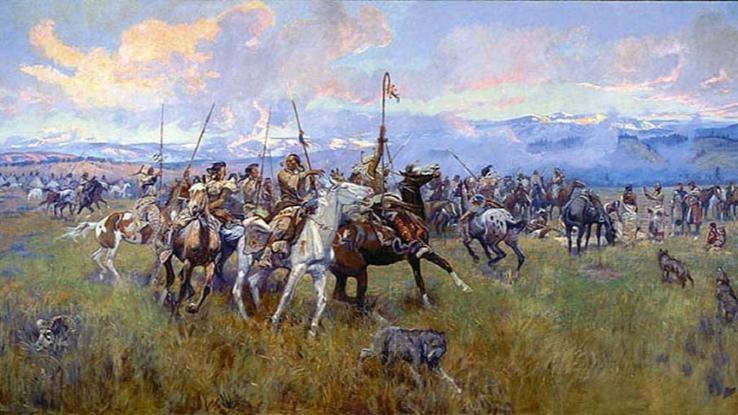
"Cagaagawia'sh, in Hidatsa, or Birdwoman, in English, has become an important effigy in both American Indian history and identity and equally an icon of the women'due south suffrage move," Alisha Deegan (Hidatsa/Sahnish), a citizen of the Mandan, Hidatsa, and Arikara Nation in Northward Dakota, and the interpretation and cultural resource program manager at Knife River Indian Villages National Celebrated Site, told Teen Faddy. Deegan goes on to note that, "There are many questions about Cagaagawia'sh and her life, just what we do know demonstrates that she was an amazing and stiff woman."
Effectually 1800, when she was just 12 years old or and then, Sacagawea and several other young Shoshone girls were kidnapped by Hidatsa warriors and, later on, enslaved. Over the next few years, Sacagawea became fluent in the Hidatsa language, a grade of Siouan language spoken in what is now considered nowadays-twenty-four hour period Northward Dakota.
Information technology'due south around this indicate in her story that details get a bit murkier. All the same, it is known that around 1803 or 1804, Sacagawea was sold every bit an enslaved person to, or "won" by, a French-Canadian fur trapper named Toussaint Charbonneau. Along with several other unknown Indigenous girls, Sacagawea was made to be one of Charbonneau's "wives." Although many history textbooks shy away from the truth, playwright and activist Carolyn Gage does non, writing that this was "a formalized kid-rape arrangement brokered by adults," who also enslaved said child.
In 1803, President Thomas Jefferson purchased western territory that had been claimed by French colonizers. Known as the Louisiana Purchase, this act nearly doubled the size of the U.s.a.. At that point, much of the middle of the continent had gone unexplored by white settlers. In club to map a safe road from the East Declension to the Pacific Bounding main, Jefferson hired explorer Meriwether Lewis and frontiersman William Clark to lead an expedition of roughly forty men upwardly the Missouri.
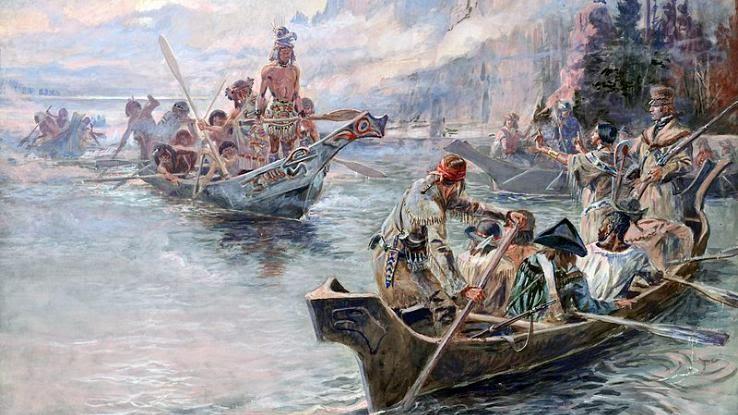
While spending the wintertime months at an encampment near the Hidatsa-Mandan villages, Lewis and Clark met Charbonneau, who angled to join the expedition as an interpreter. The explorers immune Charbonneau to join them, merely it was clear that they saw Sacagawea, who was just 16 or 17 years onetime at the time, as more than of an asset to their colonialist expedition than Charbonneau, who Lewis later called "a man of no peculiar merit" in his writings.
Non only was Sacagawea an interpreter herself, but she was too pregnant at the time, and it's clear that Lewis and Clark felt the optics of having an Ethnic mother with them — an expedition of more often than not white men — was beneficial. That is, the Corps of Discovery likely thought that Indigenous people they encountered wouldn't retrieve of them as a war party if Sacagawea was with them. While Sacagawea's abilities (and very presence) were deemed important by the Corps, it'due south important to notation that she didn't have any bureau over joining or not joining the expedition.
In improver to guiding the Corps of Discovery, Sacagawea was able to identify edible plants, communicate with other Indigenous people they encountered, and, in one instance, ensured the survival of the expedition's documentation. That is, when a boat virtually capsized, Sacagawea nerveless all of the journals, navigational tools, and provisions that might accept otherwise been lost — all while carrying her infant, and Jean-Baptiste (nicknamed "Pompey"), on her dorsum. Indebted to her efforts, Lewis and Clark named the Sacagawea River, which flows through present-day Montana, afterwards her.
In July of 1805, the trek reached the three forks of the Missouri River, which Sacagawea recognized. About a calendar month afterward, the Corps encountered Shoshone peoples and, in a twist of fate, Sacagawea realized that the principal, Cameahwait, was her brother. Past that fall, the Corps reached the Pacific Sea, thanks in large office to the horses the Shoshone people provided them.
Needing a place to prepare their winter encampment, the Corps once again leaned on Sacagawea's noesis. But determining where to install Fort Clatsop wasn't the last time Sacagawea's insights proved invaluable. In fact, on the render journey, it was Sacagawea who safely guided the group she was with through what'due south known today as the Bozeman Pass, an human action that acquired Clark to note that she had been "a pilot through this country."
Despite the instrumental role she played, Sacagawea was non given any compensation; the same was truthful for York, the enslaved Black human who also fabricated the roundtrip journey with the Corps. Sacagawea's captor, on the other hand, was given $500 and over 300 acres of state, despite Lewis' dislike of him.
Sacagewea'south Legacy Today
In that location isn't much in the style of written documentation when it comes to Sacagawea's life after the trek. Information technology is well documented that Sacagawea's son was left in the care of Clark, who was (strangely) eager to oversee the boy'south education in St. Louis. After that, Sacagawea seemingly went on fur-trading expeditions and gave birth to a daughter, Lisette, in 1812.
When it comes to her death, at that place'southward quite a bit of doubtfulness, too. While records from a fur-trading post note that she died of typhus in 1812, other accounts indicate that she didn't pass away at merely 25 years old. The National Women's History Museum points to Indigenous oral histories, some of which suggest that "Sacagawea lived for many more years in the Shoshone lands in Wyoming, until her decease in 1884."
Cultura Colectiva points out that, "In 1925, Dr. Charles Eastman, an Ethnic physician, was sent by the Agency of Indian Affairs to look for the remains of the bully Sacagawea." In retracing Sacagawea's steps, Dr. Eastman learned of a Shoshone adult female, who went by the proper noun Porivo and lived on a Comanche reservation; Dr. Eastman believed this elderberry to be Sacagawea.
"Though information technology is known that she separated from the abusive Charbonneau, little else is certain well-nigh the remainder of Sacajawea'due south life," the Brooklyn Museum notes. "Virtually Native people believe she died in 1812 at Fort Mandan and is buried somewhere on the Standing Rock Sioux reservation lands, N Dakota, while some evidence states that she lived with the Shoshone tribe for many years subsequently."
In fact, Sacagawea has 2 "official" burial sites. One, in Corson County, South Dakota, aligns with the story that she died at but 25 years old. This site, located at Fort Manuel, was placed on the National Register of Celebrated Places in 1978 every bit the final resting identify of Sacagawea, simply this completely discounts the oral history nerveless by both Dr. Eastman and Dr. Grace Hebard. The second site is located at Fort Washakie in the Wind River Reservation in Wyoming.
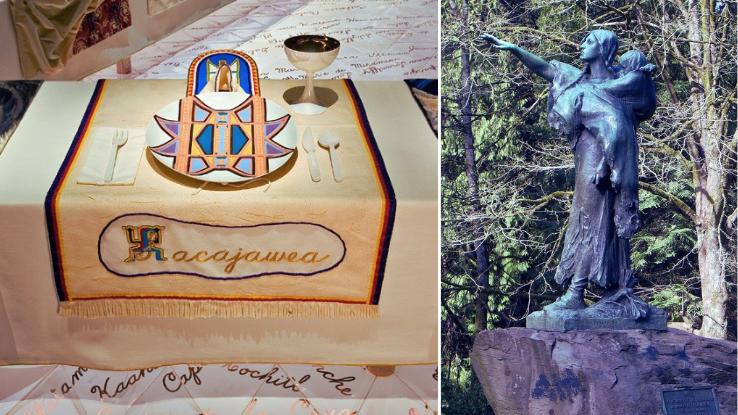
According to the National Park Service, there are more statues dedicated to Sacagawea than any other woman in American history. Unveiled in 1905, Alice Cooper's Sacagawea and Jean-Baptiste is i of the most notable monuments. Often, the sculpture is credited with inspiring at present-controversial writer Eva Emery Dye, who, in writing, cemented the romanticization and colonialist delineation of Sacagawea.
Additionally, the National American Woman Suffrage Clan, possibly not realizing the total story, saw Sacagawea as a symbol of women's independence. And, in 2000, the U.Due south. Mint aimed to honor her with a golden dollar money, but printing the likeness of someone who was enslaved by white men on currency is, to say the very least, a problematic choice.
But attempts to laurels Sacagawea go across monuments, misguided coins and named natural landmarks. In fact, she is the only Indigenous woman represented in feminist artist Judy Chicago's installation The Dinner Party, which features place settings for prominent, history-making women. "The circumstances surrounding her life have become the stuff of legend, prompting interpretation past historians, writers, and filmmakers," the Brooklyn Museum, which houses The Dinner Party, notes. "In an era in which women, particularly Native American women, were considered either weak and helpless or dangerous, Sacajawea proved to be an icon of bravery."
In a letter entitled "To the Youth / OUR FUTURE," Canadian Offset Nations creative person George Littlechild ponders Sacagawea's complicated, but of import, legacy. "It is a known fact that America glorifies historical figures such equally Lewis and Clark, that they are commemorated for opening up the Westward to 'Progress,' thus 'Civilizing' bequeathed lands," he writes. "They take become cultural icons for their deeds…. In fact what did they truly exercise for this country known as America?"
Venerated by some but rightly despised by others, Lewis, Clark and the whole trek were harbingers of the devastation, illness, and decease that was nevertheless to come up with the United States' westward expansion. "It is upward to u.s. to rewrite the history books," Littlechild writes, "to brand modify and above all to take respect for all humanity…" And, in function, that can start with looking beyond whitewashed history to understand historical figures like Sacagawea more honestly.
Source: https://www.reference.com/history/sacagawea-life-story?utm_content=params%3Ao%3D740005%26ad%3DdirN%26qo%3DserpIndex
0 Response to "Book Review of Bounce Living the Resilient Life"
Enviar um comentário